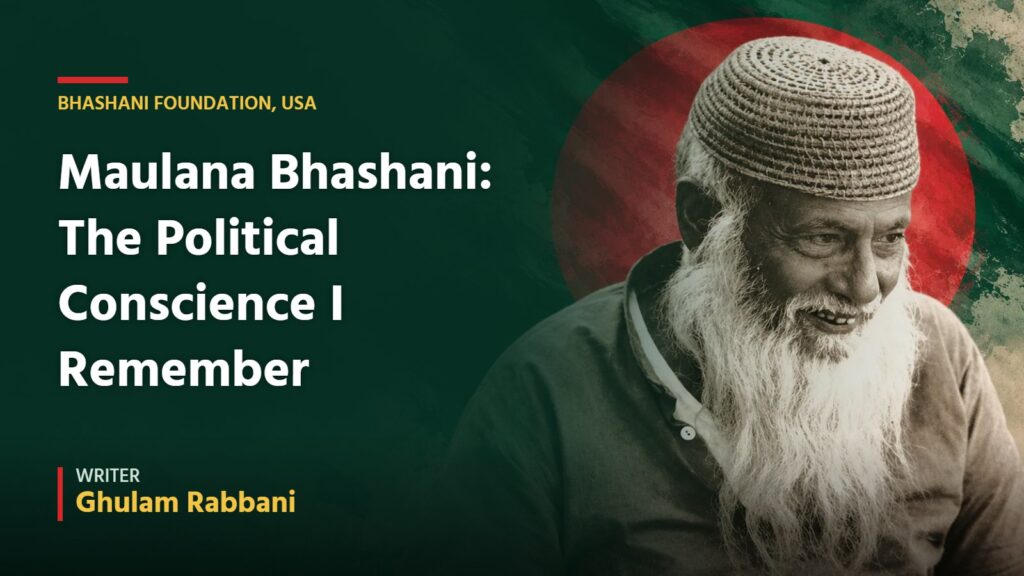
Writer: Ghulam Rabbani
Freedom Fighter, Sector 9
Bangladesh has had many political leaders, but very few have occupied the moral space that Mojlum Jononeta Maulana Abdul Hamid Khan Bhashani did.
We come from a political culture that has too often been marked by bitter divisions, personal vilification, political vengeance and, at times, violence. Leaders and followers alike have frequently been subjected to harsh invective and pejorative remarks simply because they belonged to a different political camp.
Yet Maulana Bhashani was different.
Despite his strong ideological convictions and often uncompromising political positions, he enjoyed a remarkable measure of respect across political and ideological boundaries. He was not immune from disagreement or criticism, but there was a qualitative difference in the way he was regarded. His personal integrity, simplicity and lifelong identification with ordinary people created a moral stature that was difficult to diminish through partisan attacks.
That, perhaps, is one of the rarest and most enviable tributes that can be paid to any political leader.
My First Encounters at Paltan Maidan
My admiration for Maulana Bhashani is not based simply on historical accounts or what I have read about him over the years. I had the good fortune to see and hear him personally from my school days.
During the 1960s, I attended many of his public meetings at Paltan Maidan in Dhaka. I was very young at the time, but those experiences left an impression that has stayed with me for more than half a century.
The atmosphere at his meetings was extraordinary. His fiery oratory had a force and authenticity that were difficult to ignore. He spoke not as someone seeking the approval of the ruling establishment, but as someone determined to remind those in power of their obligations to the people.
He would passionately call upon the ruling class to do right by the people, to listen to their needs and aspirations and to recognize the grievances of those who had been left behind.
For a young student witnessing these gatherings, there was something deeply inspiring about a political leader who seemed completely unafraid to challenge authority.
Looking back today, I see Maulana Bhashani as something of a guardrail in our political life, a countervailing force that stood on the side of ordinary people whenever the powerful became indifferent to their concerns.
Santosh, 1970: Seeing the Man Behind the Orator
My appreciation of Bhashani became much deeper in 1970, when I had the opportunity to attend, together with a few Dhaka college friends, a Peasants’ Conference at Santosh, Tangail, where Maulana Bhashani resided.
The gathering was particularly memorable. Alongside large numbers of peasants and ordinary people, there were international guests and a number of prominent intellectual and political personalities of the time, including Dr. Alim Al Razi, Moshiur Rahman, Rashed Khan Menon, Enayetullah Khan, Haider Akbar Khan Rono, Dr. Mahbub Ullah, Fazle Lohani, Huq, Toha, Matin, Alauddin, Deben Shikder and others.
For me, however, Santosh was significant for another reason.
It allowed me to see something of the man behind the legendary orator. I gained a much more intimate insight into his political philosophy, his simplicity, his way of life and his relationship with ordinary people. What struck me was the apparent absence of a great gulf between the leader and the people whom he claimed to represent.
His political message and personal lifestyle seemed to reinforce one another.
There was no sense that political leadership necessarily had to mean privilege, ostentation or distance from the common people. His life appeared to reflect a simplicity and commitment that gave credibility to his words.
The experience had a profound and lasting influence on me. It shaped, at least to some extent, my own understanding of justice, dignity, social responsibility and the moral obligations of political leadership.
A Voice for Those Without a Voice
Bhashani’s politics was fundamentally rooted in the lives of ordinary people.
He spoke for the peasant, the worker, the poor and the dispossessed, the people who often remained invisible to the political and economic establishment.
His significance therefore extends beyond the ideological labels that are sometimes used to describe him. He certainly had strong political and ideological convictions, but his enduring appeal came from something deeper: people believed that he genuinely cared about them.
He did not simply speak about the poor. He spoke for them and, in many ways, lived among them.
That authenticity is increasingly rare in politics.
A Political Leader Who Could Disagree Without Dehumanizing
Perhaps one of Bhashani’s most important lessons for today’s Bangladesh is that political disagreement need not become personal hatred.
He could be fiercely critical of governments, political parties and those in authority. Yet his politics was not fundamentally about personal destruction. His target was injustice, exploitation, oppression and the abuse of power.
That distinction has been lost in much of our contemporary political culture.
Today, political opponents are too often portrayed not merely as wrong but as enemies of the nation. Political differences become personal vendettas. Mutual trust disappears, and compromise is treated as weakness.
Bhashani’s political life offers a different possibility: strong convictions combined with human dignity and political courage.
What If Bhashani Had Lived Longer?
It is impossible to know how Bangladesh’s history might have unfolded had Maulana Bhashani lived longer. History does not permit us to test counterfactuals.
Yet I have often wondered whether his continued presence could have made a meaningful difference to our political development.
He possessed something increasingly scarce in politics: moral authority independent of state power.
Had he remained active during later periods of political turbulence, he might have served as a political guardian, a moral counterweight and a voice capable of restraining political excesses. His credibility among ordinary people and his ability to speak truth to power might have encouraged competing political forces to exercise greater restraint.
Perhaps his presence could have helped move our political culture toward greater tolerance, mutual respect, accommodation and trust.
We cannot know.
But it is not unreasonable to imagine that Bangladesh might have benefited from having such an independent and respected moral voice during some of its most difficult periods.
Why His Legacy Matters Today
More than five decades after my first encounters with Maulana Bhashani, many of the fundamental questions that animated his political life remain unresolved.
How do we ensure justice for ordinary citizens?
How do we protect human dignity?
How do we prevent political and economic power from becoming concentrated among privileged elites?
How do we make politics an instrument of public service rather than personal enrichment?
And perhaps most importantly, how do we disagree with one another without destroying one another?
These are not merely questions of the past. They remain central to Bangladesh’s future.
The Leader I Remember
When I look back at those gatherings at Paltan Maidan during my school days and then at the Peasants’ Conference in Santosh in 1970, I realize how fortunate I was to have witnessed a different kind of political leadership at such a formative stage of my life.
I remember the powerful voice at Paltan Maidan calling upon those in authority to do right by the people.
I remember Santosh, where I gained a glimpse of the simpler life and political philosophy of the man behind that powerful voice.
And I remember the impression he left on me, not simply as a politician, but as a human being who seemed to have dedicated his life to a cause greater than himself.
A Legacy Beyond Politics
Perhaps Maulana Bhashani’s greatest legacy is not any particular political program or ideology. It is the example of a leader whose personal integrity, sacrifice and identification with ordinary people gave him a moral stature that transcended partisan politics.
In a political culture where leaders are routinely deified by their followers and vilified by their opponents, Bhashani occupies a rare middle ground: a leader who could command respect even among many who did not share his politics.
That is an extraordinary achievement and rare distinction that set Maulana Bhashani apart from virtually all other political leaders.
Bangladesh does not need to agree with everything Maulana Bhashani believed or advocated in order to learn from his life.
We need only recognize the qualities that made him exceptional: simplicity, courage, integrity, independence, compassion for the marginalized and the willingness to speak truth to power.
The Final Reflection
For me, Maulana Bhashani will always remain more than a figure in the history books.
He is part of my own political memory.
I heard his voice at Paltan Maidan when I was a young student. I saw something of his world at Santosh in 1970. And, more than half a century later, I can still appreciate the profound moral force of what he represented.
He was a guardrail against the arrogance of power, a countervailing force for the powerless and a persistent voice for justice and dignity.
In today’s Bangladesh, perhaps that is precisely what we are missing most: a political conscience capable of rising above party, personality and power.
If Maulana Bhashani left us one enduring lesson, it is this: politics may be a struggle for power, but political leadership must ultimately be a struggle for the people.